
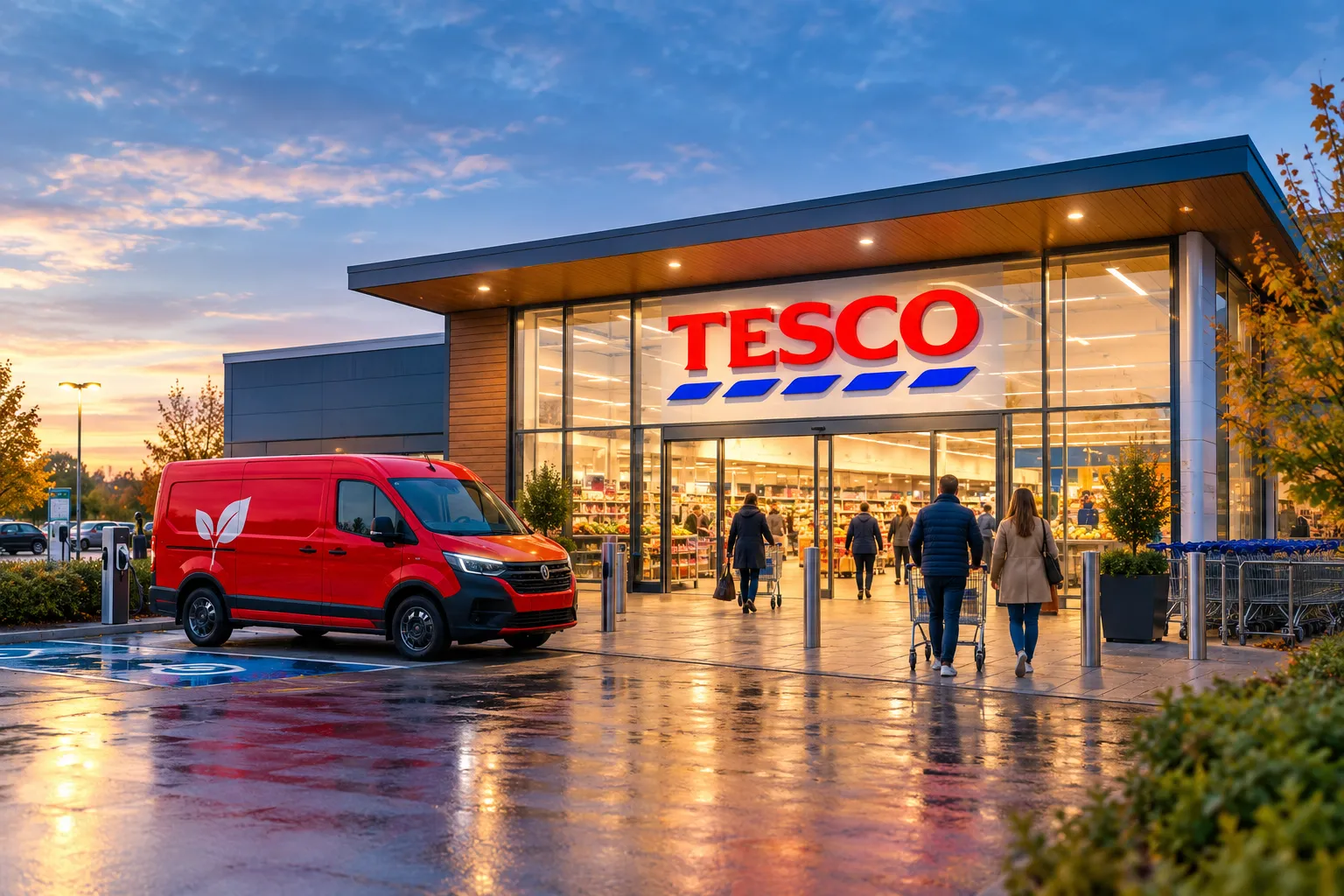
A £20 million bet on food startups. A doubled electric van fleet. Nearly 50 more banned additives in own-brand products. In a single year, Tesco has moved faster on innovation and sustainability than most retailers manage in five. As Britain’s largest supermarket chain heads into its most important trading season, the company is proving that scale and speed are not mutually exclusive.
Tesco remains the dominant force in UK grocery retail, and its latest financial results, strategic reset, and public commitments show a business actively reshaping itself for the next decade. This article breaks down what is happening at Tesco right now and why it matters to shoppers, investors, and the wider food industry.
Key Takeaways
- Tesco committed £20 million to the Bramble Fund to support early-stage UK food innovation businesses [5].
- Full-year 2026 revenue reached approximately £73.7 billion, with net income climbing to £1.79 billion.
- Tesco doubled its electric delivery van fleet in under a year, surpassing 2,000 electric vehicles [9].
- Own-brand products now restrict 114 additives, up from 65, as part of an ultra-processed food crackdown.
- Nationwide Deliveroo rollout now covers 75 UK towns and cities with rapid grocery delivery [7].
Tesco’s Financial Performance and Strategic Direction
Tesco’s fiscal 2026 numbers tell a story of steady, disciplined growth rather than explosive expansion. Revenue climbed to roughly £73.7 billion, excluding VAT but including fuel sales, up from £72.5 billion in 2025 and £69.9 billion in 2024 [6]. Net income followed a similar upward path, reaching about £1.79 billion compared with £1.63 billion the previous year.
The half-year results released in April 2026 reinforced this momentum. Adjusted operating profit reached roughly £3.15 billion, a 0.6% year-on-year increase, while headline earnings per share rose 6% to £0.29. Free cash flow jumped 12% to about £1.96 billion, giving Tesco room to reward shareholders through a final dividend of approximately £0.097 per share and full-year dividend growth of 5.8%.
Behind these numbers sits a deliberate strategic reset. According to analysis from IGD, Tesco has organized its future growth around five interconnected pillars, tightening its focus for the second half of 2026 onward [4]. The approach emphasizes more disciplined capital spending, closer integration between convenience stores and online shopping, and new attention on foodservice and “away from home” eating occasions [4].
Deutsche Bank, cited in September 2026 coverage, expected Tesco’s first-half adjusted operating profit to land near £1.725 billion, a 3% increase, even as UK like-for-like sales growth cooled. The bank maintained a “buy” rating with a 525p price target against a share price near 477p, pointing to a free cash-flow yield close to 6.6% as a sign of underlying resilience. This is analyst commentary, not a guaranteed outcome, but it reflects broad confidence in Tesco’s earnings trajectory.
How Tesco Is Investing in Food Innovation and Sustainability
Tesco’s £20 million commitment to Henry Dimbleby’s Bramble Fund, announced in late September 2026, signals a shift toward venture-style investment in the wider UK food sector [1][2][5]. The fund backs early-stage businesses working on healthier, more sustainable, and more affordable food solutions, positioning Tesco as both a retailer and an active shaper of the food ecosystem rather than a passive buyer of finished products [5].
This investment complements Tesco’s own operational changes. The grocer has expanded restrictions on additives across its own-brand ranges, moving from 65 to 114 banned or limited ingredients in 2026 as part of a broader response to consumer concern over ultra-processed foods. A new “Made Without Added Nitrites” range of ham and bacon products reflects the same instinct toward simpler, cleaner processed meat options [2].
On the environmental side, Tesco doubled its electric home-delivery van fleet in under a year, with more than 30% of delivery vehicles now electric. The 2,000th electric van was rolled out from the Hemsworth Superstore in West Yorkshire in September 2026 [2][9]. This expansion directly targets emissions from last-mile grocery delivery, one of the more stubborn sources of retail carbon output.
Community initiatives have continued alongside these commercial moves. Tesco marked 1,000 schools receiving free fruit and vegetables through a nationwide program, reinforcing its public positioning on children’s nutrition [1][2].
Tesco’s Digital Expansion and Convenience Strategy
Convenience and speed now sit at the center of Tesco’s growth plan. On 23 September 2026, Tesco completed a nationwide rollout on Deliveroo, extending rapid grocery delivery to 75 UK towns and cities after a successful trial across 147 stores [7]. Delivery windows run from 7am to 10pm, with thousands of products available in as little as 20 minutes. Clubcard Prices and Clubcard points are built into the service, tying rapid delivery back into Tesco’s core loyalty program [7].
This move places Tesco firmly inside the quick-commerce race alongside rivals already competing for impulse and top-up shopping occasions. By leveraging an existing loyalty base of millions of Clubcard holders, Tesco has a built-in advantage that newer delivery-only platforms lack.
Governance has remained steady throughout this period of expansion. Routine disclosures showed senior leaders, including CEO Ken Murphy, acquiring small share tranches under Tesco’s Share Incentive Plan in September 2026, a normal signal of management-shareholder alignment rather than any major ownership shift [8].
Tesco has also had to defend its brand reputation. According to reporting from the Guardian and BBC, the retailer has reported scam “endorsement” advertisements misusing its name to the police, while also participating in UK retail sector plans to create around 100,000 jobs for young people currently out of work [3][10].
Tesco enters the critical 2026 Christmas trading period on firmer footing than it has shown in several years. Revenue and profit are both climbing, dividend payouts are growing, and the company’s investments in food innovation, cleaner own-brand products, electric delivery, and rapid online ordering all point toward a retailer trying to stay ahead of shifting shopper expectations rather than simply reacting to them.
For shoppers, the practical takeaway is straightforward: watch for expanded rapid delivery options, cleaner-label own-brand products, and continued Clubcard-linked savings. For investors and industry watchers, Tesco’s disciplined capital allocation and steady earnings growth make it a useful bellwether for the health of UK grocery retail heading into 2026’s final quarter.
References
[1] Press Releases – https://www.tescoplc.com/press-releases [2] Media – https://www.tescoplc.com/media [3] Tesco – https://www.theguardian.com/business/tesco [4] igd – https://www.igd.com/commercial-insight/retail-analysis/retailers/tesco/articles/tesco-resets-strategic-direction-for-future-growth/73013 [5] Tesco Plc – https://www.reuters.com/company/tesco-plc/ [6] Group Balance Sheet – https://www.tescoplc.com/investors/reports-results-and-presentations/financial-performance/group-balance-sheet/ [7] Tesco Announces Major Nationwide Change 37693796 – https://www.mirror.co.uk/money/shopping-deals/tesco-announces-major-nationwide-change-37693796 [8] Reuters.com,2026 09 28:newsml Rsb5964wa:0 Reg Tesco Plc Director Pdmr Shareholding – https://www.tradingview.com/news/reuters.com,2026-09-28:newsml_RSb5964Wa:0-reg-tesco-plc-director-pdmr-shareholding/ [9] Tesco Doubles Electric Delivery Fleet In Under A Year – https://www.grocerygazette.co.uk/2026/09/14/tesco-doubles-electric-delivery-fleet-in-under-a-year/ [10] C77jz3mdmlvt – https://www.bbc.co.uk/news/topics/c77jz3mdmlvt