
A single decimal point made headlines in August 2026. When Asda Stores Limited reported like-for-like sales up just 0.2% over seven weeks, executives called it “psychologically important”, a phrase that says everything about how long the UK’s third-largest grocer has been waiting for good news[11][14]. After more than two years of falling sales, even a fractional gain counts as a turning point.
Asda Stores Limited has spent the past two years fighting to reclaim its place in Britain’s crowded supermarket sector. The retailer, majority-owned by private equity firm TDR Capital, has leaned on aggressive price cuts, store modernization, and a sprawling “Formula for Growth” plan to stop the bleeding. The financial cost has been steep, but early 2026 figures suggest the strategy may finally be gaining traction[5][10].
Key Takeaways
- Asda Stores Limited posted full-year 2025 sales of £21.0 billion excluding fuel, down 3.3%, with a statutory pretax loss widening to £989 million[2][4][5][7][13].
- Like-for-like sales turned positive in March 2026 (up 1.2%) after two negative months, and the trend continued improving through Q2 and into August[4][7][11][14].
- Net debt fell by £500 million to £3.1 billion, giving the company roughly £2.1 billion in total liquidity heading into 2026[2][7][13].
- Price cuts, better product availability, and online service upgrades are the three pillars management credits for the recent stabilization[11][14].
- Diversification through convenience stores, forecourts, George clothing, and digital shelf-edge technology is central to the recovery plan[2][3][7].
Asda Stores Limited’s Financial Reset in 2025
The numbers behind Asda Stores Limited’s 2025 performance tell a story of short-term pain. Total sales including fuel dropped 3.4% to £25.9 billion, while adjusted EBITDA after rent fell 33% to £764 million[5][2][4][7][13]. That decline reflects the cost of cutting prices aggressively to win back price-sensitive shoppers who had drifted toward discounters and rivals.
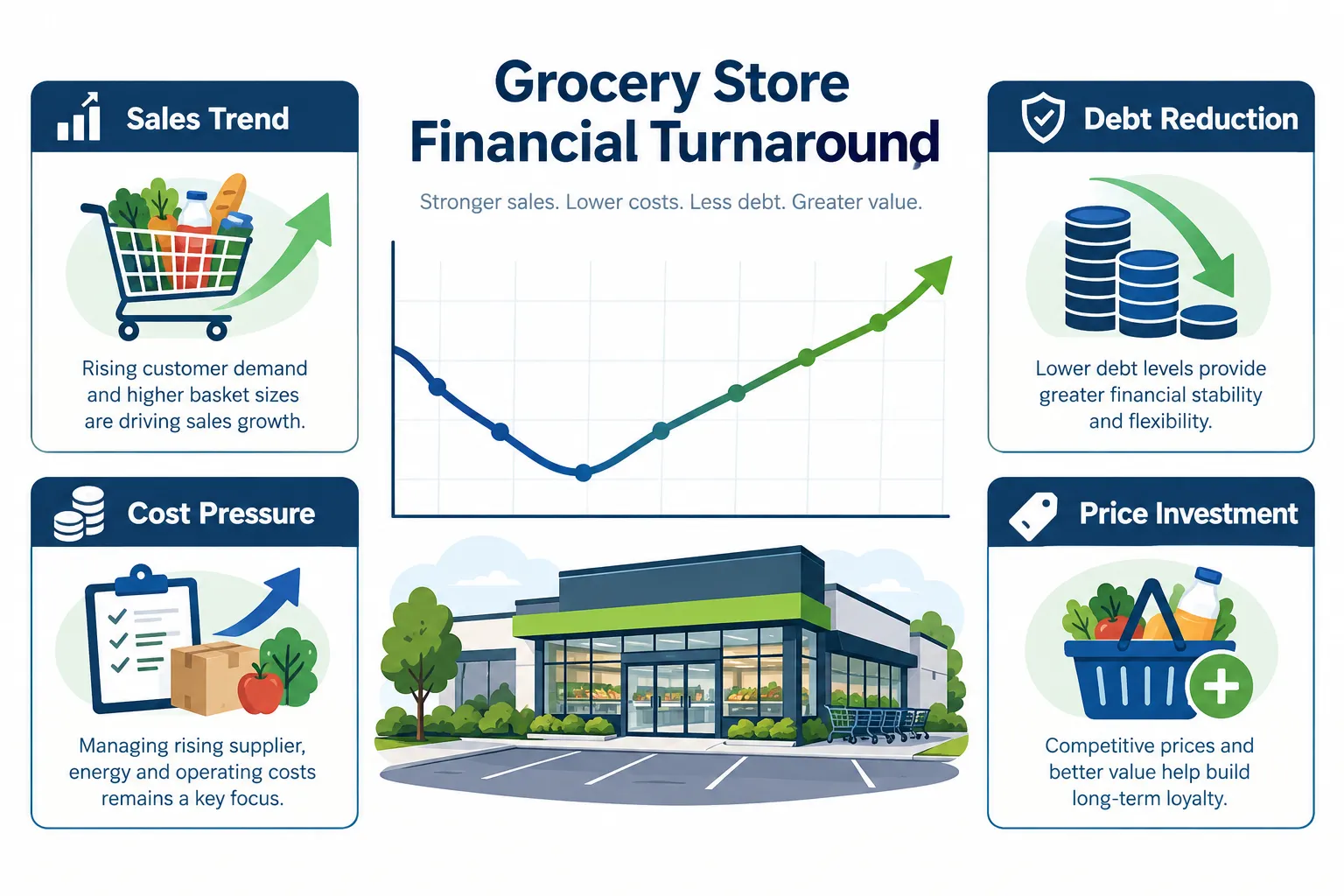
The statutory pretax loss of £989 million, up from £599 million in 2024, was driven largely by one-off restructuring costs layered on top of the price-cutting strategy[5]. Yet there is a silver lining: net debt fell by £500 million to £3.1 billion, and the company closed the year with roughly £1.3 billion in cash and £2.1 billion in total liquidity[2][4][7][13]. That financial cushion matters because it gives Asda Stores Limited room to keep investing in low prices without risking its balance sheet.
Signs of Momentum Returning
Early 2026 brought the first real evidence that the turnaround was working. Like-for-like sales stayed negative in January and February but flipped positive in March, rising 1.2%[4][7]. For the first quarter overall, sales were down just 0.8% year-on-year, or 1.3% when adjusted for Easter timing, a marked improvement on the 4.2% decline recorded in the final quarter of 2025[10].
That improvement continued into the summer. Reuters reported that Asda’s sales decline eased further thanks to better product availability and sharper prices[10]. By the seven weeks ending 18 August 2026, like-for-like sales excluding fuel rose 0.2%, a reversal from a 2.3% fall in the prior three-month stretch[11][14]. Executive chair Allan Leighton framed this as a milestone worth celebrating, even while acknowledging the recovery remains fragile[11][14].
The Strategy Behind Asda Stores Limited’s Turnaround
Three forces are driving the recovery plan at Asda Stores Limited:
- Price leadership. Leighton has pushed an explicit price-lowering strategy, betting that reclaiming value credentials will rebuild customer trust faster than any marketing campaign[5][10].
- Format diversification. The company is expanding convenience stores, forecourt sites, and its George clothing line, each seen by analysts as a genuine bright spot in an otherwise tough market[2][7][9][13].
- Technology investment. Asda has rolled out 1.2 million electronic shelf-edge labels across its Express and small-store network, enabling faster, more dynamic pricing decisions at scale[3].
Industry analysts covering Asda through outlets like IGD and Yahoo Finance describe the company as “edging forwards,” noting that George and convenience diversification offer genuine promise[2][7][9][13]. Still, the same analysts caution that market-share pressure and margin erosion remain real threats, and that rebuilding brand perception after years of underperformance will take sustained effort, not a single good quarter[2][7][9][13].
Community Commitments and Holiday Strategy
Beyond financial metrics, Asda Stores Limited continues to invest in social impact. Its long-running partnership with The Felix Project has now redistributed the equivalent of 50 million meals’ worth of surplus food to people in need across the UK[3]. That milestone sits alongside the company’s broader sustainability and community agenda.
On the commercial side, Asda is preparing a large Christmas range for 2026 featuring more than 500 products, including premium seafood, award-winning cheese, and an indulgent frozen Christmas dinner[6]. The move reflects an attempt to balance affordability with an “elevated” shopping experience, giving budget-conscious customers a reason to treat themselves without straying from Asda’s value-first identity[6].
What Comes Next for Asda Stores Limited
Analysts broadly expect Asda Stores Limited to keep investing heavily in low prices through 2026 and 2027, paired with continued convenience expansion, store refurbishments, and digital upgrades under the Formula for Growth plan[2][7][10][14]. Profitability recovery is expected to be gradual given how fiercely competitive UK grocery remains, with Tesco and Sainsbury’s both defending market share aggressively[5][10].
The central question is whether Asda can sustain price leadership without triggering further large statutory losses, while simultaneously strengthening availability, digital capability, and brand differentiation[2][7][10][14]. The company’s improved liquidity position gives it some breathing room, but the path back to consistent profitability is far from guaranteed.
Asda Stores Limited is showing its first credible signs of stabilization after a punishing stretch of declining sales and mounting losses. Price cuts, better availability, and investment in convenience and technology appear to be working, even if the gains remain small and fragile. For shoppers, the practical takeaway is that lower prices and improved in-store experience are likely to continue through 2026 and beyond. For industry watchers and investors, the next several quarters will reveal whether this early momentum can translate into durable profitability rather than a brief pause in a longer decline. Anyone tracking the UK grocery sector should watch Asda’s quarterly trading updates closely, as they will signal whether this turnaround has real staying power.